
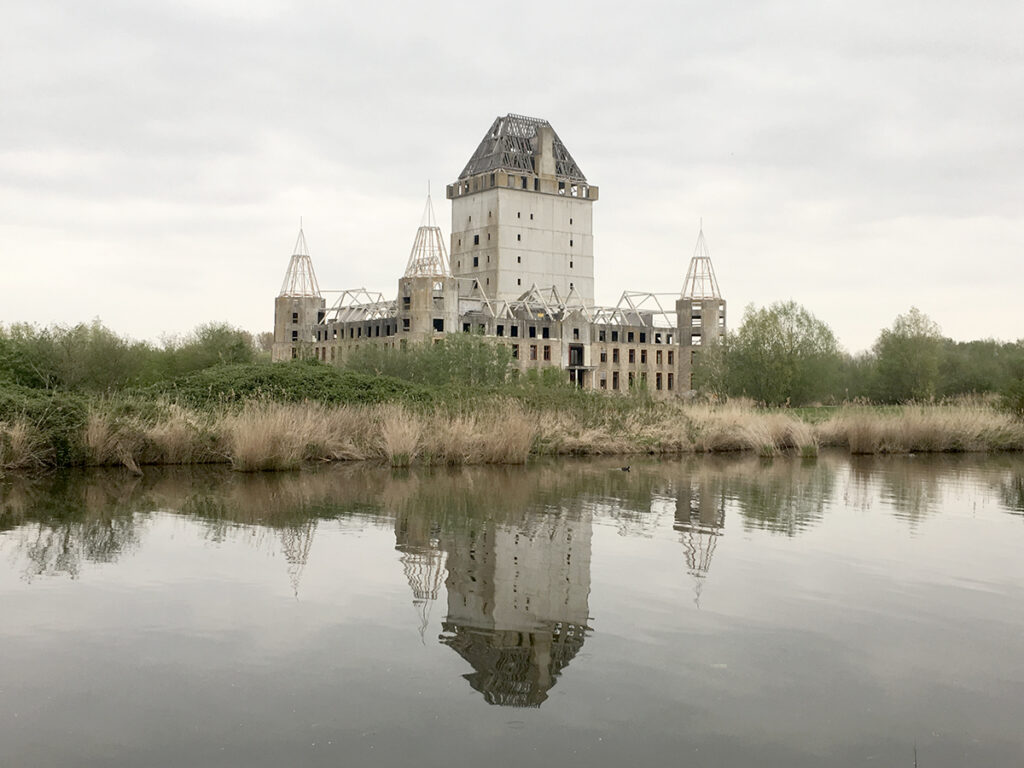
In the new land that, barely a generation and a half ago, still lay several metres underwater, stands a castle under construction. Since 2002, little seems to have changed at Kasteel Almere; in fact, draining and developing the entire province in which this modern ruin stands went considerably faster.
That the youngest city in the Netherlands would one day have its own castle was something no one foresaw during the planning of the 1970s. Almere is not only the youngest but also the fastest-growing city in the country, and its ever-windswept centre lacked an appealing wedding venue. The sleek, white and somewhat chilly town hall designed by Cees Dam in 1979 failed to charm prospective couples, who often opted instead for picturesque locations across the water, on the old land.
Partly at the initiative of alderman Cees van Bemmel, plans emerged in the late 1990s to build a suitable wedding venue for Almere—one that could also function as a hotel and conference centre. Developer Tijs Blom enthusiastically took on the project and commissioned a design modelled on his own 13th-century castle, Jemeppe in Hargimont, Belgium. On the southern edge of Almere, right beside the A6 motorway, a concrete castle rose quickly from the former seabed. And there it still stands, surrounded by a vast tract of land that, once the castle was finished, was to become a baroque garden complete with sightlines, fountains, clipped hedges, and other decorative flourishes inspired by Versailles.
For the cladding of the concrete structure, medieval bricks were imported from the Czech Republic and shipped to the reclaimed land. In the early days of construction, I once visited the site with a colourful group of architects and policymakers. Developer Tijs Blom explained that he had purchased several Czech ruins for their stone walls and had them dismantled. Architect Carel Weber replied, “Oh, they didn’t need them anymore over there?”
Not long after my visit to this medieval-castle-on-steroids, the building process faltered, and in 2002 construction was halted altogether: financing problems had emerged, involving a local RABO Bank employee who had overstepped his authority. Over the past two decades, various attempts at revival have been made—including a witch-themed amusement park called WitchWorld—but neither a hotel nor a residential district has materialised. Rumour has it that construction of 1,000 homes will begin in 2026 on the land where the baroque garden was meant to appear, on the condition that the castle itself is finally completed.
We shall see. But in truth, I would find it a shame if Kasteel Almere were fully finished. How beautiful is the irony that in this young, entirely planned landscape—where everything is measured, designed and controlled down to the last centimetre—a concrete castle stands that became a ruin before its completion, entirely by accident? They ought to leave it as it is: a monument to chance and unforeseen outcomes, right in the middle of a landscape where everything seems possible to engineer.


